
The Rise of AI Website Builders
AI web design is everywhere right now. Platforms like Wix ADI, Framer AI and Durable promise a full website in minutes.
And to be fair… they deliver. You answer a few questions, click a button, and boom — you’ve got a website.
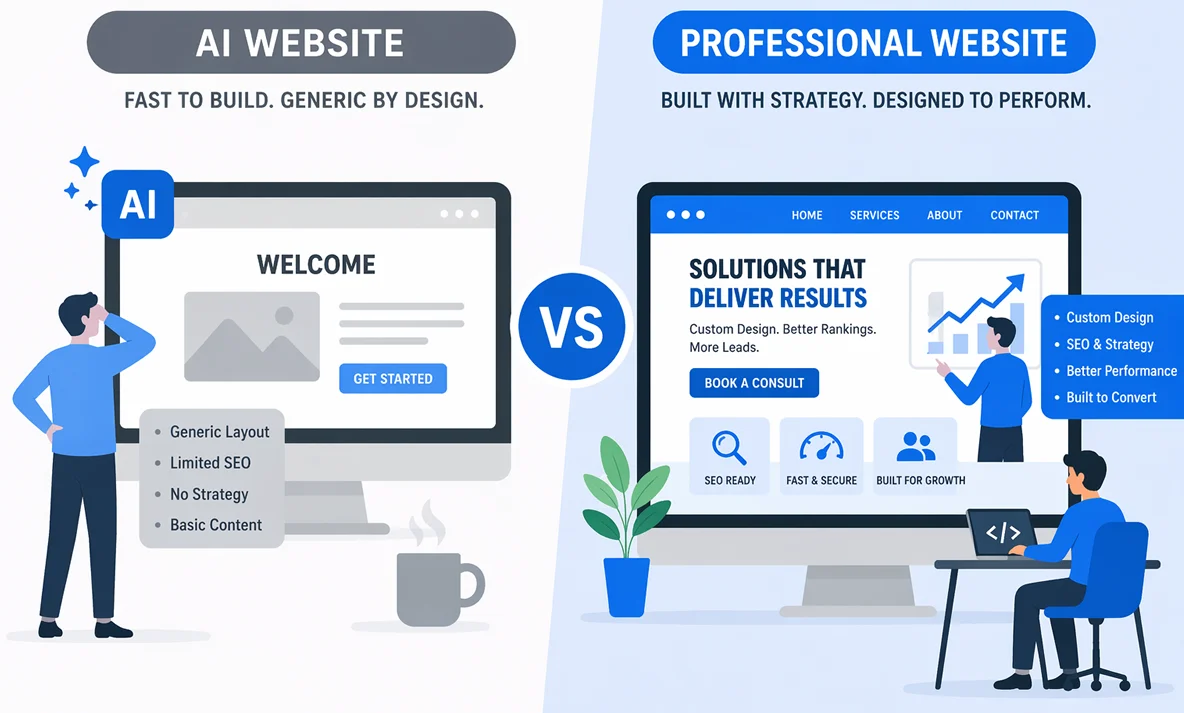
But here’s the truth most people only realise later: It looks like a website… but it doesn’t perform like one.
AI web design is on the rise, but professional web design services aren’t going anywhere. In fact, when used properly, AI becomes a powerful tool within a professionally built website. Let’s take a closer look.
Where AI Actually Shines (And Where I Use It)
Let’s be clear — AI is useful. I use it myself. Used properly, it can:
- Speed up content drafting
- Help structure service pages
- Generate ideas for blogs and FAQs
- Assist with basic layouts or wireframes
But here’s the key difference: AI is a starting point, not the finished product.
Think of it like handing a builder a rough sketch versus a full set of engineered plans. One gets you started. The other gets results.
The Problem With AI-Generated Websites
Here’s where things fall apart.
AI website builders are designed for speed — not strategy. So what do you get?
1. Generic Design That Blends In
AI pulls from patterns. That means your site ends up looking like:
- Every other tradie site
- Every other consultant site
- Every other “modern” business online
There’s no real brand thinking behind it.
2. Weak SEO Foundations
This is the big one — and where most AI sites quietly fail. They often miss:
- Proper heading structure (H1–H6 hierarchy)
- Keyword targeting strategy
- Internal linking structure
- Schema markup
- Location-based optimisation
Without these, you’re basically invisible on Google Search.
3. No Real Integration With Google Tools
This is where DIY and AI platforms really show their limits. A proper website should be connected to:
- Google Analytics
- Google Search Console
- Conversion tracking (calls, forms, clicks)
- XML sitemaps submitted correctly
Most AI builders either:
- Don’t set this up properly
- Or leave it entirely up to you (good luck if you don’t know what you’re doing)
4. No Strategy Behind the Build
This is the part AI simply can’t replicate. A proper website build considers:
- Your target audience
- Your service areas
- Your competitors
- Your revenue goals
AI doesn’t think. It assembles. And that’s a big difference.
What a Professionally Built Website Actually Does
This is where the gap becomes obvious. When I build a site, it’s not just about how it looks — it’s about how it performs.
That includes:
- Strategic SEO from Day One
- Keyword research tied to real search intent
- Service pages built to rank (not just exist)
- Location targeting (e.g. Bundaberg, Hervey Bay, Maryborough)
- Technical foundations done right
- Clean site structure
- Fast load speeds (LiteSpeed, caching, image optimisation)
- Mobile-first performance
- Proper schema implementation
- Full Google integration
- Analytics tracking configured correctly
- Search Console connected and monitored
- Sitemap submission and indexing checks
- Conversion-focused design
- Clear calls to action
- User journey planning
- Trust signals and credibility elements
The Real Role of AI Moving Forward
AI isn’t replacing web designers. It’s replacing bad web design. The kind that:
- Was templated and left as-is
- Had no real strategy behind it
- Was built just to “have a website”
For businesses that actually want leads, growth and visibility? AI still needs a professional behind it.
Templates Aren’t the Problem — How They’re Used Is
Most modern websites, including those built on platforms like Avada or Elementor, start with a base layout or framework.
That’s not a shortcut — it’s just efficient. The difference comes in what happens next.
AI builders typically stop at the template. Content gets filled in, images get swapped out and the site goes live.
A professionally built website doesn’t stop there.
- Layouts are reworked based on how users actually navigate.
- Content is written around real search terms, not guesses.
- Pages are structured for SEO, speed, and conversions.
AI uses templates as the final product. I use them as the starting point. What starts as a template becomes something completely customised — built to perform, not just exist.
AI still needs a professional behind it. Anyone can launch a website now. Very few can build one that actually works.
The Smart Approach: AI + Experience
The best results right now come from combining both. Use AI for:
- Drafting content
- Brainstorming ideas
- Speeding up workflows
Then bring in experience for:
- Strategy
- SEO
- Performance
- Conversion
That’s the difference between:
👉 A website that exists
👉 And a website that works
Final Thoughts
AI can build you a website in minutes. But it won’t rank it, track it or grow your business.
That still takes strategy, experience and the right set up from day one.
Book your free consultation and get clear direction on your website →
Frequently Asked Questions About AI Web Design
The Rise of AI Website Builders
AI web design is everywhere right now. Platforms like Wix ADI, Framer AI and Durable promise a full website in minutes.
And to be fair… they deliver. You answer a few questions, click a button, and boom — you’ve got a website.
But here’s the truth most people only realise later: It looks like a website… but it doesn’t perform like one.
AI web design is on the rise, but professional web design services aren’t going anywhere. In fact, when used properly, AI becomes a powerful tool within a professionally built website. Let’s take a closer look.
Where AI Actually Shines (And Where I Use It)
Let’s be clear — AI is useful. I use it myself. Used properly, it can:
- Speed up content drafting
- Help structure service pages
- Generate ideas for blogs and FAQs
- Assist with basic layouts or wireframes
But here’s the key difference: AI is a starting point, not the finished product.
Think of it like handing a builder a rough sketch versus a full set of engineered plans. One gets you started. The other gets results.
The Problem With AI-Generated Websites
Here’s where things fall apart.
AI website builders are designed for speed — not strategy. So what do you get?
1. Generic Design That Blends In
AI pulls from patterns. That means your site ends up looking like:
- Every other tradie site
- Every other consultant site
- Every other “modern” business online
There’s no real brand thinking behind it.
2. Weak SEO Foundations
This is the big one — and where most AI sites quietly fail. They often miss:
- Proper heading structure (H1–H6 hierarchy)
- Keyword targeting strategy
- Internal linking structure
- Schema markup
- Location-based optimisation
Without these, you’re basically invisible on Google Search.
3. No Real Integration With Google Tools
This is where DIY and AI platforms really show their limits. A proper website should be connected to:
- Google Analytics
- Google Search Console
- Conversion tracking (calls, forms, clicks)
- XML sitemaps submitted correctly
Most AI builders either:
- Don’t set this up properly
- Or leave it entirely up to you (good luck if you don’t know what you’re doing)
4. No Strategy Behind the Build
This is the part AI simply can’t replicate. A proper website build considers:
- Your target audience
- Your service areas
- Your competitors
- Your revenue goals
AI doesn’t think. It assembles. And that’s a big difference.
What a Professionally Built Website Actually Does
This is where the gap becomes obvious. When I build a site, it’s not just about how it looks — it’s about how it performs.
That includes:
- Strategic SEO from Day One
- Keyword research tied to real search intent
- Service pages built to rank (not just exist)
- Location targeting (e.g. Bundaberg, Hervey Bay, Maryborough)
- Technical foundations done right
- Clean site structure
- Fast load speeds (LiteSpeed, caching, image optimisation)
- Mobile-first performance
- Proper schema implementation
- Full Google integration
- Analytics tracking configured correctly
- Search Console connected and monitored
- Sitemap submission and indexing checks
- Conversion-focused design
- Clear calls to action
- User journey planning
- Trust signals and credibility elements
The Real Role of AI Moving Forward
AI isn’t replacing web designers. It’s replacing bad web design. The kind that:
- Was templated and left as-is
- Had no real strategy behind it
- Was built just to “have a website”
For businesses that actually want leads, growth and visibility? AI still needs a professional behind it.
Templates Aren’t the Problem — How They’re Used Is
Most modern websites, including those built on platforms like Avada or Elementor, start with a base layout or framework.
That’s not a shortcut — it’s just efficient. The difference comes in what happens next.
AI builders typically stop at the template. Content gets filled in, images get swapped out and the site goes live.
A professionally built website doesn’t stop there.
- Layouts are reworked based on how users actually navigate.
- Content is written around real search terms, not guesses.
- Pages are structured for SEO, speed, and conversions.
AI uses templates as the final product. I use them as the starting point. What starts as a template becomes something completely customised — built to perform, not just exist.
AI still needs a professional behind it. Anyone can launch a website now. Very few can build one that actually works.
The Smart Approach: AI + Experience
The best results right now come from combining both. Use AI for:
- Drafting content
- Brainstorming ideas
- Speeding up workflows
Then bring in experience for:
- Strategy
- SEO
- Performance
- Conversion
That’s the difference between:
👉 A website that exists
👉 And a website that works
Final Thoughts
AI can build you a website in minutes. But it won’t rank it, track it or grow your business.
That still takes strategy, experience and the right set up from day one.
Book your free consultation and get clear direction on your website →